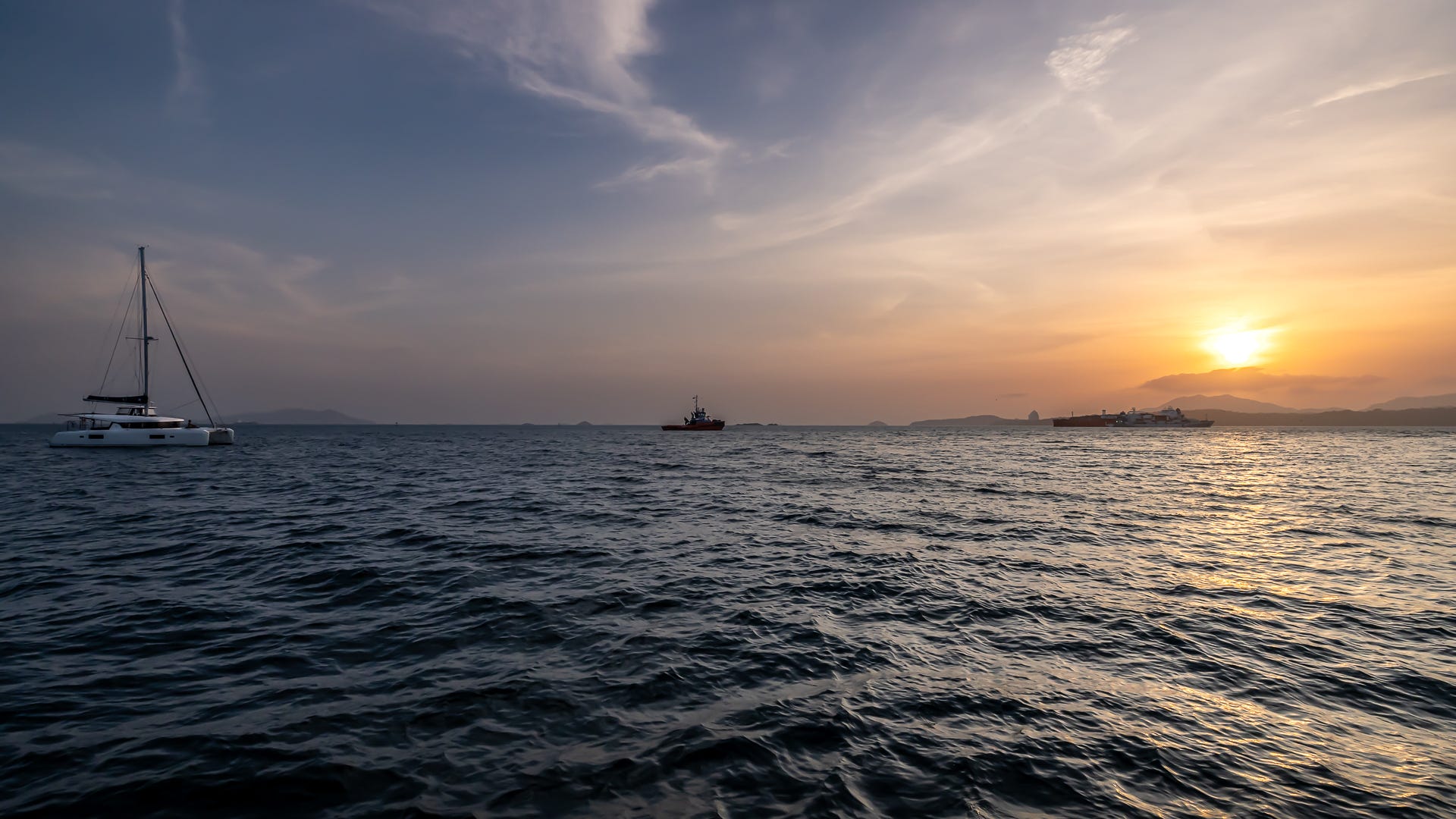
We sailed to Grenada on Saturday, June 29th, two days before the hurricane hit. Our nerves were already on edge after the fiasco in Carriacou. There, a confused old sailor was motoring around the harbour with his anchor down, hooked our chain, and dragged us behind, all while yelling, “I’ve got no fingers,” as if that could explain what was happening. And I guess it did. Twenty-four hours later, we anchored at a nearly full Secret Harbour on Grenada’s southern coast to prepare for the storm. It was a small cove surrounded by short green hills and mangroves, with room for a dozen boats at most. A perfect hurricane hole, if no one else came in.
We were scheduled to haul out at Clark’s Court Marina on July 1st, the day the storm was expected to hit. But there was no chance. Even if the storm tracked north as forecast, the winds would still be too high for the crane. We were stuck there.
So we prepared to ride out the storm in that small anchorage. We took the sails down, removed the enclosures, and secured the cockpit. We then watched in horror as hour after hour, boats continued to arrive. By the end of the day, the anchorage was so cramped that if anyone dragged, and many surely would, there would be carnage.
At four in the morning, I woke up to check the weather projections. I got nauseous. Hurricane Beryl had formed into a Category 5 monster storm and refused to track north. It was now expected to hit the north coast of Grenada in the early morning of July 1st. The southern coast would see winds exceeding 80 knots. Worse yet, we would get southwest winds and swell that would funnel through the bay, transforming that peaceful cove into a washing machine.
“What’s going on?” Yolanda asked, still half asleep.
“It’s not good,” I said.
“Does it involve death and destruction?”
“Yup.”
“Let’s get the fuck out of here,” she said.
Still in the dark, we unpacked and reinstalled the sails, submitted the required passage plan to Trinidad’s coast guard, and began motoring south across the bay. We faced an uncertain 14-hour sail to Trinidad.
The local WhatsApp groups were buzzing with panicked sailors like us, wondering what to do about immigration and the consequences of leaving without clearing customs. Would we even be allowed to enter Trinidad? “Just come over, and we’ll sort it out here,” said Jesse James. The legendary cruising advocate in Trinidad was working tirelessly with the authorities to assist the hundreds of yachts trying to escape the storm. His magic worked. Trinidad welcomed us all with open arms.
“I hope we are not the only idiots leaving without clearing out,” I said. We left the bay and pointed our bow south towards Port of Spain. Within minutes, as the sun peeked over the horizon, the answer appeared: hundreds of sails surrounded us in all directions. Sailboats, fishing boats, trawlers, tankers, and ferries—all pointing south, all trying to save their boats and themselves. The great migration of 2024 had begun.
For 14 hours, we sailed in the company of friends and strangers under sunny skies on a perfect beam reach. By late evening, we lined up at the entrance of the narrow Bocas del Dragón channel and motored our way into a different world. Oil platforms lit up the sky like miniature cities protruding from the ocean. But everything else was dark. The wind was gone, the waters calm, and silence was all around. We snaked through the dozens of islands that surround Port of Spain until we finally dropped anchor in Williams Bay. We could finally breathe.
We stayed up for hours in the quiet anchorage, waving as boat after boat arrived from Grenada. Tired sailors with relieved faces, some smiling, some still in shock.
And there we waited for a storm that we barely felt. But to our north, Carriacou was devastated. Hundreds of boats that had hauled out at the Tyrrell Bay boatyard were destroyed. Not a single boat at anchor was spared. We knew many of them. Close friends who lost it all. And I thought about the guy with no fingers, and wondered if he got out of there in time.


Story Notes & Book Updates:
Thank you for reading. I’d love to hear your thoughts in the comments section below. If you enjoy this story, click “like” to help more readers discover it.
This is a true story that happened in the summer of 2024. Ironically, we sailed to Grenada at the end of June because our insurance required us to be in Grenada by July 1st, the official start of the hurricane season. Grenada was supposed to be outside the hurricane zone. We weren’t the only ones. Hundreds of boats from all the Caribbean had sailed there that June. Hurricane don’t go that south. Hurricanes don’t form that early in the season. Well, Zeus surely had a wicked sense of humor that year.
In book news, Hiva Oa, my first novel, is officially in the query trenches! I worked with an editor to polish the query package in December and sent the first large batch of query letters at the start of the year.
I’ll soon be working on the next draft of The Last Harbour, my second novel. I received very helpful feedback from beta readers, and I’m very excited about this project. It’s a dystopian story about three sailboats crossing the Pacific when global conflict erupts. I hope it will become a series, as I already have book two and three mapped out in my head :-). There will be lots of writing in 2026!
About Me
I’m Nestor Lopez-Duran, writing under the pen name N.L. Duran. I am a former psychology professor now sailing around the world with my wife on our sailboat named Blue Buddha. The stories published in Currents & Wind are inspired by the people, places, creatures, and events I encounter at sea.


